

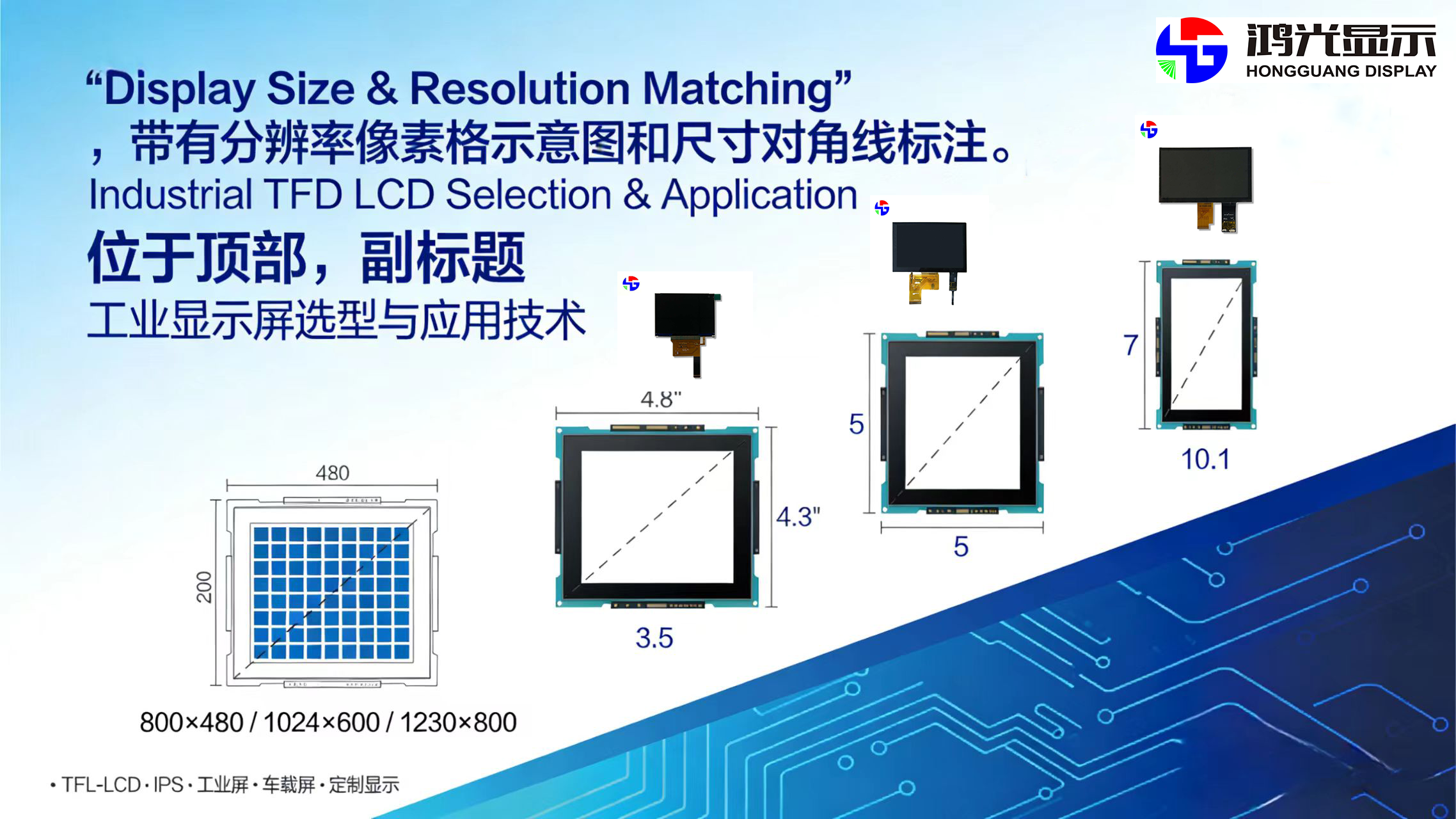
 Display screen size and resolution matching: Selection Guide and Application suggestions
In fields such as industrial control, smart home, in-vehicle display, and medical equipment, whether the size and resolution of the display screen are reasonably matched directly determines the display effect, visual experience, hardware compatibility, and overall cost of the product. This article, from a practical application perspective, explains the matching principles of display screen size and resolution, common combinations, and key points for selection, helping users quickly choose the most suitable screen.
- What are display screen size and resolution
– Size: It refers to the length of the diagonal of the screen. The commonly used unit is inch, such as 3.5 “, 4.3 “, 5 “, 7 “, 10.1 “, etc.
– Resolution: The number of pixels in the horizontal and vertical directions of the screen, such as 480×320, 800×480, 1024×600, 1280×800, etc.
The denser the pixel points are, the clearer and more detailed the picture will be, but the requirements for the driver board, main control performance and picture materials will also be higher.
Ii. Matching Principles of Size and Resolution
- Moderate clarity
Under the same size, the higher the resolution, the finer the picture. However, once it exceeds the recognition range of the human eye, the improvement is not obvious, and it will also increase the cost and driving difficulty.
- Adapt to the main control platform
The resolutions supported by different single-chip microcomputers, ARM, and industrial control motherboards are limited. It is necessary to choose a combination that can be directly driven by hardware.
- Comply with the usage distance
High resolution is available for close-range operation (handheld and desktop devices). When viewing from a distance (such as in advertising machines or vehicles), priority should be given to ensuring brightness and size.
- Balance cost and power consumption
High resolution usually comes at a higher cost and consumes more power. In industrial and automotive scenarios, mature, stable and cost-effective combinations are preferred.
Iii. Common size and resolution Standard Combinations for Industrial/Commercial Screens
3.5 inches
– Standard resolution: 320×240
– Applicable: Small instruments, handheld devices, and panels of small household appliances
4.3 inches
– Standard resolution: 480× 272/800 ×480
– Application: Access control, car rearview mirrors, small industrial control screens
5.0 inches
– Standard resolution: 480× 272/800 ×480
– Applicable: Smart home central control, medical small screens, car navigation
7.0 inches
– Standard resolution: 800× 480/1024 ×600
– Applicable: Industrial HMI, home appliance central control, in-vehicle multimedia
8.0 inches
– Standard resolution: 1024× 768/1280 ×800
– Application: High-end industrial control, medical display, in-vehicle central control
10.1 inches
– Standard resolution: 1024× 600/1280 ×800
– Application: Industrial tablets, advertising machines, vehicle-mounted large screens, medical equipment
15.6 inches and above
– Standard resolution: 1366× 768/1920 ×1080
– Applicable: Industrial displays, commercial displays, medical imaging equipment
Iv. How to Choose the Best Match for Your Product
- Small size (3.5 “- 5”
Preferred options: 480× 272/800 ×480
Features: Low cost, simple drive, stable and reliable, meeting the needs of most small devices.
- Medium size (7 “- 10.1”
Preferred options: 800× 480/1024 ×600
Features: Clarity and cost balance, it is the most universal solution for both industrial and automotive applications.
- High-definition demand products
Available options: 1280×800/1920×1080
Applicable to: High visual requirements, video playback, and image display devices.
- Industrial/vehicle-mounted strong stability is preferred
Do not blindly pursue high resolution. Give priority to mature screen modules with wide temperature range, high brightness and long lifespan.
- Summary
The size of the display screen determines the visual size, and the resolution determines the fineness of the picture.
Reasonable matching can not only ensure a clear and comfortable display effect, but also reduce the difficulty and cost of hardware.
In fields such as industrial control, automotive, smart home, and medical care, it is recommended to give priority to the use of mature industry standard combinations and conduct overall selection in combination with working temperature, brightness, interface, and touch control methods.

