

Key Technical Considerations When Integrating a Round TFT LCD Module
Integrating an LCD module into an electronic product requires more than selecting a suitable screen size. Engineers need to understand its display structure, electrical interface, optical specifications, temperature range and installation requirements.
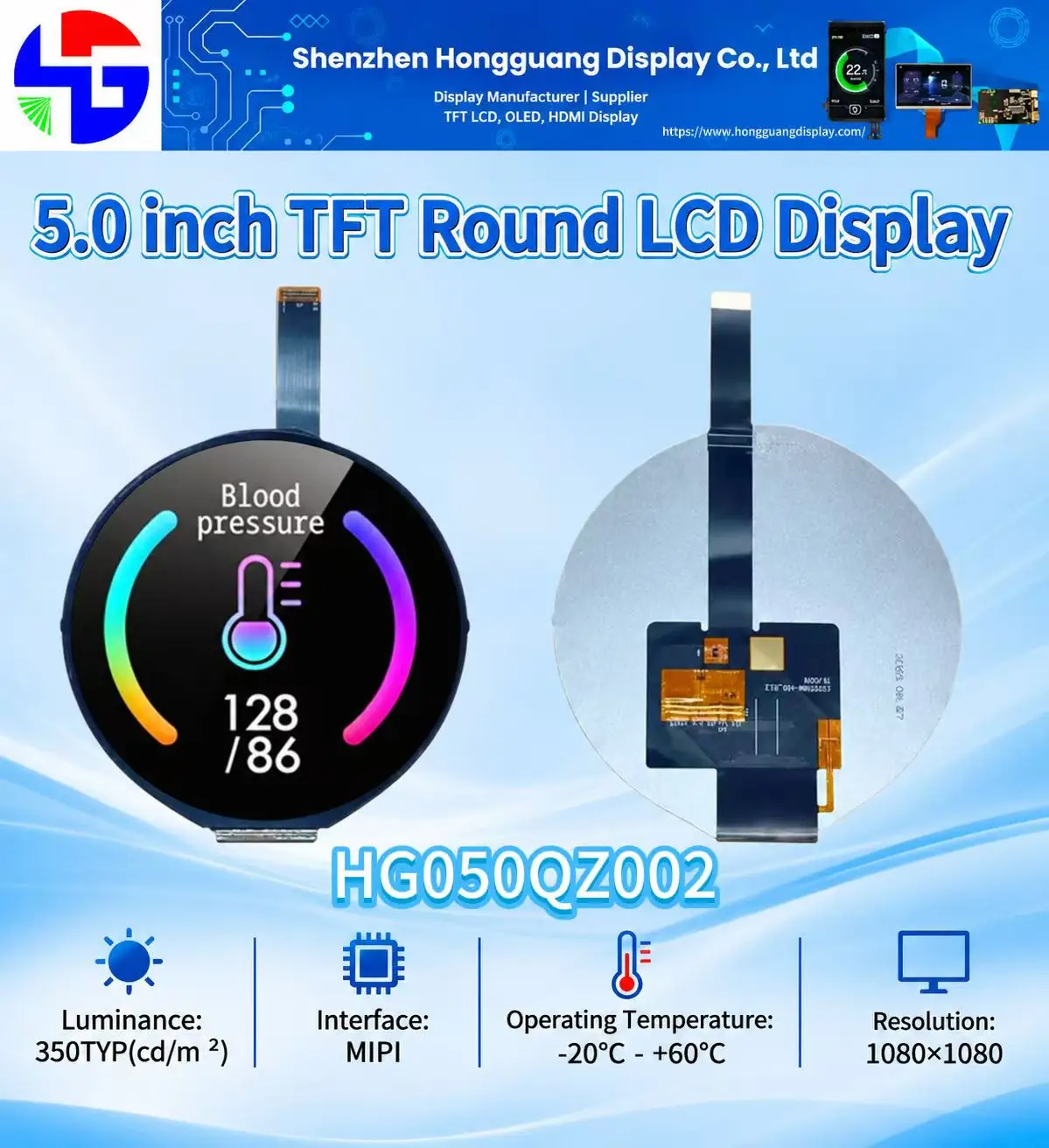
The HG050QZ002 is a 5.0-inch round TFT LCD module from Hongguang Display. Its technical specification provides several important details for product designers and hardware engineers.
1. TFT-LCD Structure and Display Mode
The HG050QZ002 is a color active-matrix TFT-LCD panel using LTPS TFTs as active switching devices. The module consists of a TFT-LCD panel, a driving circuit and a backlight system.
It operates in transmissive mode with a normally black display configuration. The panel supports a resolution of 1080 horizontal by 1080 vertical pixels and displays 16.7 million colors.
2. MIPI Interface and Connector
Interface compatibility is an important part of LCD integration. The HG050QZ002 uses a MIPI 50PIN interface with a Hirose DF40C-50DP-0.4V connector.
Its pin configuration includes MIPI data lanes, clock signals, power connections, ground connections and control signals.
Before connecting the module to a motherboard, engineers should carefully check the pin assignment, power requirements and interface design.
3. Understanding Optical Specifications
Optical performance affects how displayed content is presented to users. According to the specification, the HG050QZ002 has a typical luminance of 350 cd/m² and a typical contrast ratio of 1300:1.
Its viewing angle is specified at 70° minimum and 80° typical in both horizontal and vertical directions. The typical NTSC color gamut is 70%, with a minimum value of 65%.
The typical response time is 40 ms.
These values are based on the testing conditions described in the technical document.
4. Operating Temperature Requirements
Temperature is another important factor in display integration. The operating temperature range of this module is -20°C to +60°C, while the storage temperature range is -30°C to +75°C.
These two ranges serve different purposes and should not be confused during product design.
5. Installation and ESD Protection
LCD panels contain delicate glass and electronic components. The specification recommends avoiding excessive mechanical pressure, strong impacts and vibration.
The FPC should be handled carefully, and appropriate electrostatic discharge protection should be used during assembly. The module should not be connected or disconnected while the system is powered on.
Long-term display of fixed patterns should also be avoided because image sticking may occur.
Conclusion
Understanding the technical details before integration helps engineers evaluate whether an LCD module matches their equipment requirements.
With its MIPI interface, 1080 × 1080 resolution and defined optical and temperature specifications, the HG050QZ002 provides important technical information for electronic product development.
For detailed specifications, please contact Hongguang Display.

